
An Unexamined Life Is Not Worth Living
A Christian’s Call to Examine Faith, Convictions, and Actions
Someone recently asked me a question: “After publishing 23 books this year, are you working on anything new?”
I smiled and answered, “I have one more for this year.”
The title is An Unexamined Life Is Not Worth Living: A Christian’s Call to Examine Faith, Convictions, and Actions.
When asked why I am rushing to get so many books published, my answer was simple: Time is not my friend right now, and I don’t know what tomorrow will hold.
That may sound like a sobering answer, but it is an honest one. We all like to believe we have plenty of time. We make plans for next year, five years from now, and sometimes even decades down the road. Yet none of us has been promised tomorrow. I have become increasingly aware that the time we are given is a gift, not a guarantee. I want to use whatever time I have left to share the things I believe are important, particularly when it comes to faith, Christianity, and the responsibility we have toward one another.
This latest book is especially near and dear to my heart.
Why This Book Matters Now
Look around us. Once again, as the midterm elections approach, we see people retreating into their respective corners, waiting for the bell to ring so they can come out fighting. Political conversations become arguments. Friendships become strained. Families find themselves divided. People who once sat across the dinner table and enjoyed one another’s company suddenly discover that they cannot discuss politics without becoming adversaries.
Unfortunately, Christians are not immune to this behavior.
We see people professing their faith on Sunday morning and then displaying an entirely different attitude toward others on Monday. We see Christians defending their political positions with more passion than they demonstrate when defending their faith. We see anger, bitterness, name-calling, and an unwillingness to listen.
And perhaps the most troubling part is that many believe they are doing God’s work simply because they believe their political position is correct.
But is that what Christ calls us to do?
That is one of the questions I want readers to consider.
Faith Must Be Examined
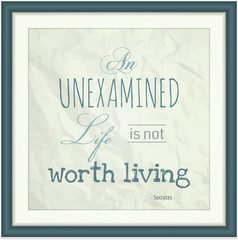
The title of this book is inspired by the famous statement attributed to the Greek philosopher Socrates: “The unexamined life is not worth living.”
Although Socrates was speaking from a philosophical perspective, the principle has an important application to Christianity.
How many of us have actually examined what we believe? How many have questioned why we believe it? How many have taken the time to determine whether our convictions are consistent with Scripture?
It is easy to call ourselves Christians. It is much harder to examine whether our daily lives reflect the teachings of Jesus Christ.
Do we love our neighbors as ourselves? Do we forgive those who offend us? Do we show compassion toward people with whom we disagree? Do we practice humility, patience, and self-control? Are we willing to acknowledge when we are wrong?
These are not insignificant questions. They go to the very heart of what it means to follow Christ.
Christianity is not simply a label we wear or a collection of beliefs we defend. It is a commitment that should influence how we think, how we speak, how we treat others, and how we conduct ourselves.
If our actions contradict our professed beliefs, perhaps it is time for some serious self-examination.
Christians and the Responsibility to Vote
One chapter in this book addresses something that I believe deserves considerably more attention: how Christians should approach voting and their responsibilities as citizens.
I believe Christians have an obligation to participate in the political process. Our faith should influence our understanding of right and wrong, our convictions, and the decisions we make when choosing our elected representatives.
But there is a distinction between allowing our faith to guide our political decisions and allowing politics to control our behavior.
A Christian should examine candidates, their positions, their records, and the principles they represent. We should consider whether their policies are consistent with the moral convictions we derive from Scripture.
However, we must also remember that our responsibility does not end when we cast a ballot.
How do we treat someone who voted differently? Can we disagree without becoming disagreeable? Can we defend our convictions without attacking someone’s character? Can we recognize that another person has the same right to participate in the political process that we do?
Most importantly, do we remember that our allegiance to Jesus Christ must come before our allegiance to any political party, candidate, or ideology?
No political party is the Church, and no politician is the Savior.
We can be passionate about our convictions without abandoning the principles Jesus taught us. We can stand firmly for what we believe is right while treating others with dignity and respect.
That is not weakness. It is Christian maturity.
The Questions We Must Be Willing to Ask
This book is not being written to tell readers what political party to support or to provide another collection of arguments for one side or the other. It is intended to challenge Christians to look inward before pointing fingers outward.
Are our convictions grounded in Scripture, or have we simply adopted the opinions of those around us?
Do we apply biblical principles consistently, even when doing so challenges our personal preferences?
Are we more concerned with winning an argument than demonstrating Christlike behavior?
Do we measure our success by how many people agree with us, or by how faithfully we live according to the teachings of Jesus?
These questions require honesty. And honesty sometimes requires us to confront things about ourselves that we would rather ignore.
That is the purpose of examining our lives.
Why I Am Writing This Book
I have published 23 books this year, and I have one more that I hope to complete before the year ends. Some might ask why I continue to push myself. The answer is that I believe there are things worth saying, lessons worth sharing, and questions worth asking.
I don’t know how much time I have left to write these books. None of us knows how much time we have left to do the things we believe God has called us to do.
I don’t want to spend that time simply adding more titles to a bookshelf. I want to write books that make people think, challenge assumptions, encourage reflection, and, hopefully, bring readers closer to understanding God’s Word.
An Unexamined Life Is Not Worth Living is my invitation to Christians to take an honest look at themselves.
Before we criticize our neighbors, examine our own behavior. Before we condemn someone else’s convictions, examine the foundation of our own. Before we demand that others live according to Christian principles, make certain we are doing our best to live by them ourselves.
We may not agree on every political issue. We may never see eye to eye on every social question. But if we call ourselves followers of Jesus Christ, we should at least agree that His teachings deserve to guide our lives.
Perhaps the most important question we can ask ourselves is not whether we are right about everyone else, but whether our own lives reflect the faith we profess.
Time is precious. Tomorrow is not guaranteed. Let’s make the time we have count.
And let’s begin by examining the one life we are each responsible for: our own.