
Where Are the Seven Deadly Sins Found in the Bible?
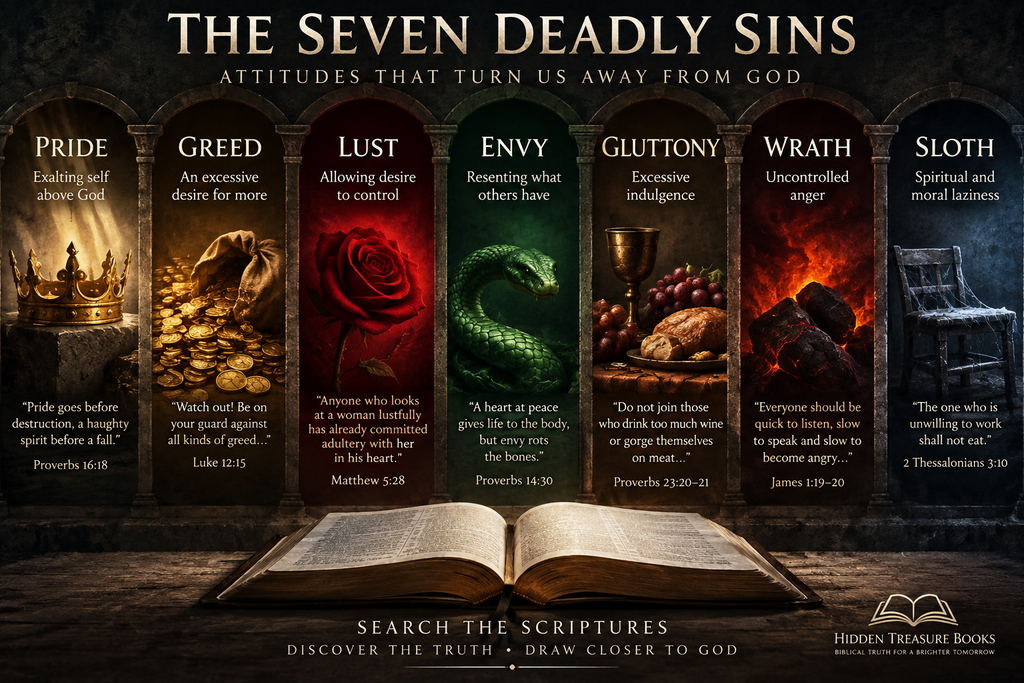
When people hear the phrase “Seven Deadly Sins,” they often assume the Bible contains a specific list of seven sins. But does it?
If you open your Bible and search for a chapter titled “The Seven Deadly Sins,” you will not find one.
You will not find a single verse that says:
Pride, greed, lust, envy, gluttony, wrath, and sloth are the seven deadly sins.
So, where did the idea of the Seven Deadly Sins in the Bible come from? And more importantly, does Scripture actually teach about these seven sins?
The answer requires an important distinction.
The Bible does not present the Seven Deadly Sins together as one official list. Instead, Scripture repeatedly addresses each of these sinful attitudes, desires, and behaviors throughout the Old and New Testaments.
The traditional Seven Deadly Sins are:
- Pride
- Greed
- Lust
- Envy
- Gluttony
- Wrath
- Sloth
Although these seven are not listed together in one biblical passage, they are all addressed through biblical teaching.
That distinction is important because, in a Bible study, the Bible must remain our authority.
The purpose of studying the Seven Deadly Sins is not to create a list that Scripture never created. Instead, it is to examine what God’s Word teaches about the sinful attitudes that can take root in the human heart.
Does the Bible List the Seven Deadly Sins?
The short answer is no—not as a single list.
There is no chapter or verse containing all seven names together.
However, that does not mean the seven sins are absent from Scripture.
In fact, the Bible contains extensive teaching about pride, greed, sexual desire, envy, excessive appetites, anger, laziness, self-control, and the condition of the human heart.
The Seven Deadly Sins can therefore be viewed as a framework for studying biblical teaching about sin.
This is an important distinction.
We should never force the Bible to say something it does not say.
Instead, we should allow Scripture to speak for itself.
That is the approach we will take throughout this Bible study: Scripture first, tradition second.
Why Does the Bible Talk So Much About Sin?
To understand the Seven Deadly Sins, we first need to understand how the Bible describes sin.
Sin is not simply a collection of bad actions.
Jesus taught that sin begins in the heart.
In Matthew 15:19, Jesus said:
“For out of the heart come evil thoughts—murder, adultery, sexual immorality, theft, false testimony and slander.”
This statement gives us an important key to understanding the biblical teaching on sin.
What happens on the outside often begins on the inside.
A sinful action can begin with a sinful thought.
A sinful behavior can begin with a sinful desire.
A sinful decision can begin with an attitude that has been allowed to grow within the heart.
That is why the study of the Seven Deadly Sins is about much more than identifying bad behavior.
It is about examining the condition of our hearts.
The Seven Deadly Sins and Their Biblical Foundations
Let’s look briefly at each of the seven and where the Bible addresses the underlying sin.
1. Pride
Pride is one of the most frequently warned-against attitudes in Scripture.
Proverbs 16:18 says:
“Pride goes before destruction, a haughty spirit before a fall.”
James 4:6 gives an even stronger warning:
“God opposes the proud but shows favor to the humble.”
Biblical pride is not the same thing as healthy confidence or recognizing the gifts God has given us.
Pride becomes sinful when we elevate ourselves above God, reject His authority, or believe that we know better than He does.
The story of King Nebuchadnezzar in Daniel 4 provides one of Scripture’s clearest examples of pride and its consequences.
After looking at his great kingdom, Nebuchadnezzar declared:
“Is not this the great Babylon I have built… by my mighty power and for the glory of my majesty?”
—Daniel 4:30
God humbled him.
Eventually Nebuchadnezzar recognized God’s authority and declared:
“Those who walk in pride he is able to humble.”
—Daniel 4:37
Pride can convince us that we are independent of God.
That is precisely why it is so dangerous.
2. Greed
Greed is an excessive desire for wealth, possessions, power, or more of what we already have.
Jesus warned about it directly.
Luke 12:15 says:
“Watch out! Be on your guard against all kinds of greed; life does not consist in an abundance of possessions.”
Notice that Jesus did not say that possessions themselves were sinful.
The warning was against greed.
The problem begins when possessions become more important than God.
Greed whispers:
“I need more.”
Faith responds:
“God has provided.”
The Bible repeatedly warns us not to allow material possessions to become our master.
3. Lust
Lust involves allowing sexual desire to become sinful and controlling.
Jesus addressed the issue at the level of the heart.
Matthew 5:28 says:
“Anyone who looks at a woman lustfully has already committed adultery with her in his heart.”
Jesus’ teaching is significant because He moved the discussion beyond outward behavior.
The heart matters.
Our thoughts matter.
Our intentions matter.
The Bible teaches us that what we allow to grow within our minds and hearts can eventually influence our actions.
4. Envy
Envy occurs when we become dissatisfied with what we have because someone else possesses something we desire.
Proverbs 14:30 says:
“A heart at peace gives life to the body, but envy rots the bones.”
Envy can be difficult to recognize because it can remain hidden.
We can congratulate another person while secretly wishing we had what they possess.
We can become resentful when someone else succeeds.
We can even become unhappy when another person receives a blessing.
Envy shifts our attention away from gratitude and toward comparison.
Instead of asking, “What has God given me?”
We begin asking:
“Why didn’t God give me what they have?”
That question can reveal something important about the heart.
5. Gluttony
Gluttony involves excessive indulgence and a lack of self-control concerning physical appetites.
The Bible repeatedly addresses excessive eating, drinking, and the importance of self-control.
Proverbs 23:20–21 warns against those who overindulge.
Paul also describes people whose “god is their stomach” in Philippians 3:19.
The larger biblical principle is self-control.
God created us with appetites.
Eating is not sinful.
Enjoying food is not sinful.
The danger comes when an appetite becomes our master.
When our desires begin controlling us instead of being controlled by us, we have a spiritual problem.
6. Wrath
Anger itself is not always sinful.
There are circumstances in which anger can be appropriate.
But the Bible repeatedly warns against uncontrolled anger.
James 1:19–20 says:
“Everyone should be quick to listen, slow to speak and slow to become angry, because human anger does not produce the righteousness that God desires.”
Wrath goes beyond simply becoming angry.
It is anger that is allowed to take control.
It can lead to hatred, revenge, bitterness, violence, and destruction.
Wrath says:
“You hurt me, so I will hurt you.”
God calls His people toward patience, forgiveness, mercy, and self-control.
7. Sloth
Sloth is perhaps the least understood of the Seven Deadly Sins.
Being tired is not sinful.
Resting is not sinful.
Jesus Himself withdrew from the crowds and rested.
The biblical concern is with laziness, neglect, irresponsibility, and failing to fulfill responsibilities.
Proverbs repeatedly warns against laziness.
Paul writes in 2 Thessalonians 3:10:
“The one who is unwilling to work shall not eat.”
The Parable of the Talents in Matthew 25 also teaches about responsibility and faithfully using what God has entrusted to us.
Sloth asks:
“Why should I bother?”
Faith asks:
“What has God called me to do?”
Where Are the Seven Deadly Sins Found in Scripture?
Now we can answer the question that began this article.
Where are the Seven Deadly Sins found in the Bible?
They are found throughout Scripture rather than in one specific list.
| Deadly Sin | Examples of Biblical Passages |
| Pride | Proverbs 16:18; James 4:6; Daniel 4 |
| Greed | Luke 12:15; 1 Timothy 6 |
| Lust | Matthew 5:28 |
| Envy | Proverbs 14:30 |
| Gluttony | Proverbs 23:20–21; Philippians 3:19 |
| Wrath | James 1:19–20 |
| Sloth | Proverbs; 2 Thessalonians 3:10; Matthew 25 |
These passages do not create one official biblical list called “The Seven Deadly Sins.”
Instead, they demonstrate that the individual sins and the principles behind them are addressed repeatedly throughout God’s Word.
Why Are They Called “Deadly” Sins?
The word “deadly” should cause us to stop and think.
Sin is not harmless.
Scripture teaches that sin separates humanity from God and leads to death.
Romans 6:23 says:
“For the wages of sin is death, but the gift of God is eternal life in Christ Jesus our Lord.”
The Seven Deadly Sins are therefore not seven sins that are somehow worse than every other sin.
Rather, they represent sinful attitudes and desires that can become deeply rooted within us and lead to other sinful behaviors.
Your heart matters.
Your thoughts matter.
Your desires matter.
And ultimately, your relationship with God matters.
The Common Thread: Self Instead of God
When we examine these seven sins carefully, we begin to see something they have in common.
Pride says, “I know better than God.”
Greed says, “I need more.”
Lust says, “I want what I want.”
Envy says, “I want what you have.”
Gluttony says, “I want more of what satisfies me.”
Wrath says, “I will make you pay.”
Sloth says, “I don’t want to do what is required of me.”
At the center of each can be the elevation of self over God.
That is why this study is not simply an examination of seven bad habits.
It is an examination of the human heart.
This Study Begins With the Heart
The goal of studying the Seven Deadly Sins should not be to identify sinful people around us.
It should begin with ourselves.
The Bible is a mirror.
It shows us who we are and reveals where we need to change.
As we move through this study, we will examine each of the Seven Deadly Sins individually and look carefully at what Scripture says about them.
We will ask difficult questions.
What is pride?
How does greed take control of our lives?
When does desire become lust?
Why does envy destroy contentment?
How can our appetites control us?
When does anger become wrath?
What happens when we become spiritually lazy?
And perhaps most importantly:
What does God want us to do about it?
The purpose of this study is not condemnation.
It is transformation.
The goal is not simply to know more about sin.
The goal is to recognize sin, turn away from it, and draw closer to God.
The Seven Deadly Sins may not appear together on one page of the Bible.
But the lessons behind them are found throughout God’s Word.
And our journey begins with the first—and perhaps most dangerous—of them all:
Pride.
Key words
Seven Deadly Sins in the Bible
- Where are the Seven Deadly Sins found in the Bible
- Seven Deadly Sins Bible study
- seven sins in the Bible
- biblical Seven Deadly Sins
- seven deadly sins scripture
- pride greed lust envy gluttony wrath sloth
- what are the Seven Deadly Sins
- does the Bible list the Seven Deadly Sins
- sins mentioned in the Bible
- Bible teaching about sin