Bruce Becker: Christian Author, Writer, and the Story Behind His Books
Who Is Bruce Becker?
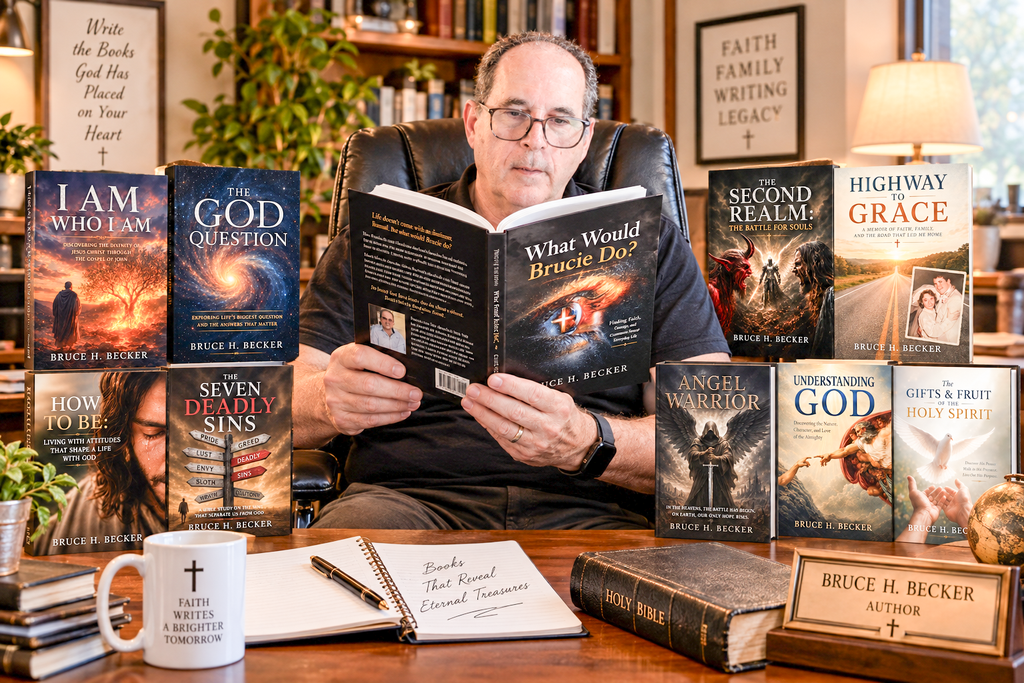
Someone once asked me, “Who is Bruce Becker?”
I really didn’t have a good answer.
It was a strange question because I knew who I was—or at least I thought I did. I knew where I had been, what I had done, who I had married, who my children and grandchildren were, and the jobs I had held throughout my life. But when someone asks you to explain who you are, that is a much harder question.
So, I started thinking about it.
Maybe the best way to explain who Bruce Becker is isn’t by listing accomplishments. Maybe it is by explaining how I got here—and how a lifetime of experiences eventually led me to become a Christian author and writer.
I grew up the youngest of three children. Being the youngest taught me a few things. One was that if I kept my head down, stayed out of trouble, and let my older siblings get blamed for things, I might actually make it into adulthood.
That didn’t always work.
I was a dreamer.
I had ideas. Lots of them.
Sometimes those dreams got me into trouble. Eventually, I learned that not every idea needed to be acted upon, and I became pretty good at managing my expectations. I learned to keep some of those ideas to myself and, for the most part, live under the radar.
But I never stopped thinking.
That would become one of the defining characteristics of my life—and eventually, one of the reasons I became an author.
From the United States Army to a Life of Ideas
When I joined the United States Army, I eventually found myself serving in the Veterinary Corps. Part of my responsibility involved food inspection.
I remember wishing someone would put me in a back room somewhere and simply say:
“Bruce, redesign the way we inspect food facilities.”
That would have been heaven to me.
I didn’t just see the system as it existed. I saw ways it could work better.
The problem was that someone was usually already assigned to improve that particular system.
And sometimes my ideas stepped on somebody’s toes.
I would develop an idea, build a working model, and present it. Occasionally, the person responsible for the particular military standard or program would call me and tell me, in one way or another, to back off.
My response was usually pretty simple.
“I’ll give you the idea. You can take the credit for it.”
You would think that would solve the problem.
It didn’t.
Pride is a funny thing.
Sometimes the person would rather keep things the way they were than accept an idea from someone who wasn’t officially assigned to make the change.
So I would back off.
That person would eventually finish their assignment, get transferred, and leave.
Then someone new would arrive.
And I would start all over again.
Round two.
Looking back, I realize something important about myself.
I wasn’t necessarily looking for recognition.
I wanted to solve problems.
I wanted to make things better.
And I wanted to build something that worked.
That tendency followed me long after I left the Army.
From the Army to Wal-Mart and Food Defense
When I worked for Wal-Mart, food defense became a major concern.
Once again, I started thinking.
We already had a system for food safety called Hazard Analysis and Critical Control Points—HACCP.
I asked myself a simple question:
Why couldn’t we apply the same philosophy to food defense?
Instead of asking only, “What could make this food unsafe?”
Why not also ask:
“What could someone intentionally do to make this food unsafe?”
From that thinking came the concept of Security Analysis and Critical Control Points.
The philosophy eventually became an accepted way of thinking about food defense.
Did I receive much credit?
Not really.
But by that point in my life, I had learned something.
Sometimes the idea is more important than the name attached to it.
I was also asked to create a Good Agricultural Audit for Wal-Mart.
I did.
Again, I wasn’t particularly interested in becoming famous for it.
I simply wanted to create something useful.
SAFE: Building Something That Could Last
Another chapter of my professional life brought me to the National Food Processors Association, which would eventually go through name changes and become part of what was known as the Grocery Manufacturers Association.
I became the director of the SAFE program—Supplier’s Assessments for Food Excellence.
This time, I had the opportunity to watch something I helped build grow.
The program expanded under my leadership and eventually was sold to a certification body.
That experience taught me another lesson.
Ideas are easy.
Building something that survives is much harder.
You have to take the idea, organize it, test it, explain it, defend it, improve it, and convince other people that it is worth using.
That process was probably more important to my future as an author than I realized at the time.
Because that is exactly what writing books would eventually require.
An idea wasn’t enough.
I had to turn the idea into something other people could understand.
Why Bruce Becker Started Writing Books
Eventually, I retired.
And I thought I knew what the rest of my life would look like.
I figured I would keep my head down, enjoy my family, enjoy retirement, and eventually God would call me home.
Then something happened that changed the way I looked at the rest of my life.
I was diagnosed with Parkinson’s disease.
Suddenly, time became much more important.
I began thinking about things I had never really thought seriously about before.
What would happen to my wife if something happened to me?
What would happen to the things I had accumulated?
What would happen to my stories?
What would my grandchildren know about me?
What would remain after I was gone?
I realized that some of the things I had spent my entire life creating were temporary.
A program could be replaced.
A job could be filled by somebody else.
A title could disappear.
Even professional accomplishments eventually become lines on a résumé that nobody remembers.
But stories can survive.
Words can survive.
Ideas can survive.
And perhaps most importantly, memories can survive.
That was when I started taking my writing seriously.
Where Do Bruce Becker’s Book Ideas Come From?
People sometimes ask me where I get the ideas for my books.
The honest answer is that I don’t really know.
Something happens.
I see something.
I hear something.
Someone asks me a question.
I remember something from my past.
And then a voice inside my head starts talking.
Once that happens, I have a choice.
Either I ignore it, or I do something about it.
Usually, I do something about it.
The first book I ever wrote took months.
And, honestly, it wasn’t very good.
It was called Planet Earth, Meet Your God.
The idea was to create a resource that youth groups could use to explain the attributes of God.
My wife eventually put it on her website, and we simply left it there for anyone who wanted to use it.
I didn’t think much more about it.
But the seed had been planted.
Angel Warrior
The second book I wrote was Angel Warrior.
This one was a little different.
In the first version, I used the names of real people.
And if you know anything about my military career, you can probably guess what happened next.
Some of the people who had made my military life miserable became characters in my book.
Let’s just say they weren’t the good guys.
Fortunately, wisdom eventually caught up with me.
When I decided to revisit the manuscript years later, I changed the names and reworked the story.
When Parkinson’s entered my life, Angel Warrior was the first manuscript I pulled out of the drawer.
It had been sitting there for years.
And suddenly I realized something:
Maybe these old ideas weren’t dead.
Maybe they had simply been waiting for me.
Turn, Turn, Turn
Then came Turn, Turn, Turn.
This book came from a different place.
I wrote it because I needed to hear the message myself.
There are times in life when everything seems to go wrong. We question God. We question ourselves. We wonder why we are going through what we are going through.
I knew I wasn’t the only person who had ever felt that way.
So I wrote.
The funny thing was that the book seemed to write itself.
The problem was that it wouldn’t stop writing.
It kept getting longer and longer.
Eventually, the manuscript needed someone to step in and say, “Bruce, enough.”
The good people at Digital Book Publishings helped me find the heart of the story and capture the most important parts.
And that became the book you see today.
The Seven Deadly Sins
Then I reached backward.
I went back to my Catholic upbringing and my years as a Catholic Youth Minister.
That became The Seven Deadly Sins.
When I was a young Catholic Youth Minister, I was much more passionate about defending the positions of the Church.
Age has a funny way of changing a person.
Over the years, I became more forgiving.
I learned that people don’t always need someone standing across from them arguing about who is right.
Sometimes they simply need someone willing to sit beside them and listen.
The Seven Deadly Sins allowed me to return to something familiar while looking at it through the eyes of the person I had become.
The Gifts and Fruit of the Holy Spirit
Next came The Gifts and Fruit of the Holy Spirit.
With this book, I wanted to reach a broader audience.
I deliberately moved away from denominational theology and focused much more heavily on Scripture.
I wanted the Bible to speak for itself.
That became an important part of my writing philosophy.
I don’t want to tell people what they should believe simply because Bruce Becker says so.
I want to give them something to think about.
I want them to open the Bible.
I want them to ask questions.
And I want them to discover the answers.
How to Be: Exploring the Beatitudes
Then came How to Be.
Years earlier, when I was training to become an instructor at Fort Sam Houston, Texas, one of our assignments was to develop teaching materials and overheads for a class.
My instructor allowed me to create my assignment around the Beatitudes.
I called it The How To Be Attitudes.
I kept that material.
Years later, I realized I wasn’t finished with it.
That old military training assignment became the foundation for another book.
It also introduced two characters who would become very important to me:
Lukas and Charlie.
Lukas is my grandson, and Charlie is his cousin.
And once those two characters entered my writing, something changed.
My books weren’t just about ideas anymore.
They were becoming personal.
The Second Realm
Then came The Second Realm.
My son has a good friend named Sean who lives with Muscular Dystrophy.
I wanted to give Sean something.
Not something purchased from a store.
Something created specifically for him.
So I wrote a story and used his name.
I dedicated the book to him.
That book reminded me that writing doesn’t always have to serve a commercial purpose.
Sometimes you write because you want someone to know they mattered enough for you to create something for them.
The God Question
My sister was struggling with her faith.
She had a question that many people have asked:
Why do bad things happen to good people?
I didn’t have a simple answer.
Maybe nobody does.
But instead of simply trying to answer her question in a conversation, I wrote a book.
That became The God Question.
I used her question as the starting point and expanded the book to address other reasons people struggle to believe in God.
Writing it forced me to confront questions that aren’t always comfortable.
And I think that’s a good thing.
Faith that has never been questioned may not be very strong faith.
Sometimes we have to ask the difficult questions before we can appreciate the answers.
Understanding God
The second book featuring Lukas and Charlie was Understanding God.
It went back to an idea similar to my first book, Planet Earth, Meet Your God.
I wanted to explain who God is, what Christians believe about Him, and why they believe it.
But this time, I had more life experience behind me.
I had learned more.
I had questioned more.
And I had become much more comfortable admitting that I didn’t have every answer.
Maybe that is one of the most important things age teaches us.
When you’re young, you think you know everything.
When you get older, you begin to realize how much you don’t know.
Highway to Grace
Highway to Grace was probably the most fun book I have written.
Every family has stories.
Some are serious.
Some are embarrassing.
Some make you laugh every time you remember them.
And some make you wonder how everyone survived.
I took some of those memories, added a little creativity, and turned them into a book.
The message was simple:
Christians aren’t perfect.
Sometimes Christians have bad days.
Sometimes we make stupid decisions.
Sometimes we laugh at the wrong time.
Sometimes we mess things up.
Grace doesn’t mean we never fail.
Grace means failure doesn’t have to be the end of our story.
I AM Who I AM: Exploring Who Jesus Is
Then came I AM Who I AM.
This book started with an interview.
I was asked how I would bring non-believers into the Christian faith.
I gave what I thought afterward was a pretty poor answer.
And it bothered me.
I kept thinking about the question.
Eventually, I came to a conclusion.
If I wanted to explain Christianity to someone who didn’t believe, perhaps I shouldn’t begin by telling them what they needed to believe.
Perhaps I should begin with Jesus.
If I could make the case for the divinity of Christ, then the rest of the Christian story would have a foundation.
So I went back to the Gospel of John.
I found what I needed there.
And I wrote the book.
Once again, a question became a manuscript.
The Bible Detectives
And then there is The Bible Detectives.
This one is different.
I originally wrote it as one very long book.
My publisher looked at the manuscript and said something along the lines of:
“Bruce, this could be a series.”
They were right.
It eventually became ten books.
But the real reason I wrote The Bible Detectives has very little to do with publishing.
It has everything to do with my granddaughter, Gabi.
Gabi and her mother, Rachel, have lived with us since Gabi was an infant.
In many ways, Gabi became like my fourth child.
I loved raising Christopher, Rachel, and Caitlyn.
But by the time Gabi came along, Pop Pop was getting a little older.
I couldn’t always do all the crazy things I had done with my three children.
So I found another way to spend time with her.
I wrote.
The Bible Detectives became my way of taking the questions children ask and turning them into adventures.
It became a way for Gabi to learn about Jesus, the Bible, faith, prayer, and the questions that sometimes make adults uncomfortable.
But there was another reason.
I wanted Gabi to have a piece of me.
Not just a photograph.
Not just a story someone told her.
Not just memories that would eventually fade.
I wanted her to be able to pick up a book years from now and hear my voice.
I wanted her to know what Pop Pop thought.
I wanted her to know what Pop Pop believed.
And most of all, I wanted her to know how much Pop Pop loved her.
What Would Brucie Do? (W.W.B.D.)
Then there is What Would Brucie Do?, or W.W.B.D.
In some ways, this book is probably the most personal of all the books I have written.
The title came from a simple idea.
We’ve all heard the question, “What would Jesus do?”
It’s a question that has challenged Christians for generations.
But I started thinking about something else.
What would happen if, before making a decision, I asked myself:
“What would Brucie do?”
Not because I thought I had all the answers.
I don’t.
And certainly not because I think my way of doing things is always the right way.
It isn’t.
In fact, some of the lessons I’ve learned throughout my life came from doing things the wrong way first.
What Would Brucie Do? is really about the lessons I’ve learned through life—lessons about faith, family, mistakes, relationships, responsibility, and trying to do the right thing when the right thing isn’t always obvious.
The book reflects the person I have become after decades of living, working, making mistakes, raising a family, serving my country, asking questions, and trying to understand what God expects from me.
It isn’t a book about being perfect.
Quite the opposite.
It is about recognizing that we are all works in progress.
Sometimes we make the right decision.
Sometimes we don’t.
Sometimes we say the right thing.
Sometimes we wish we could take back what we said.
And sometimes we have to learn the hard way.
That’s part of being human.
The title What Would Brucie Do? also reflects something I’ve come to understand about teaching.
People don’t always learn from being told what to believe.
Sometimes they learn better when someone tells them what that person has experienced.
That’s what I try to do in this book.
I share experiences, thoughts, mistakes, and lessons I’ve learned along the way.
Then I leave the reader to decide what they can take from them.
Ultimately, What Would Brucie Do? isn’t really asking the reader to become more like Bruce Becker.
It is asking the reader to stop for a moment and think before acting.
To ask questions.
To consider the consequences.
To think about faith.
To think about other people.
And perhaps most importantly, to ask what God might want us to do.
Maybe that’s the real lesson behind W.W.B.D.
Before we ask, “What would Brucie do?”
Perhaps we should ask:
“What would God want me to do?”
And sometimes, finding that answer is the beginning of wisdom.
Bruce Becker’s Christian Books Are About Questions
When I look at the books I’ve written, I see a common thread.
Questions.
Questions about God.
Questions about faith.
Questions about Jesus.
Questions about suffering.
Questions about sin.
Questions about grace.
Questions about what it means to be a Christian.
And questions about life itself.
I don’t believe every difficult question has a simple answer.
But I do believe difficult questions are worth asking.
That philosophy has shaped me as a Christian author.
I don’t want my readers simply to accept everything I write.
I want them to think.
I want them to question.
I want them to explore Scripture.
And, ultimately, I want them to discover something for themselves.
So, Who Is Bruce Becker?
After writing all these books, maybe I finally have an answer to that original question.
Who is Bruce Becker?
I’m a husband.
I’m a father.
I’m a grandfather.
I’m a retired soldier.
I’m a person who spent much of his professional life trying to make systems work better.
I’m a man who has made mistakes.
I’m a man who has asked difficult questions.
I’m a man whose faith has changed and matured over the years.
I’m a dreamer.
Apparently, I never completely learned how to stop being one.
I am also someone who has finally realized that ideas don’t have to disappear just because the person who had them eventually does.
That may be the real reason I write.
I don’t write because I think every book is going to change the world.
It probably won’t.
I don’t write because I expect everyone to agree with me.
They won’t.
I don’t even write because I think everything I have written is brilliant.
Trust me.
I’ve read some of my early work.
It isn’t.
I write because somewhere along the way, I discovered that the thoughts in my head could become something that might help someone else.
A question could become a book.
A memory could become a story.
A problem could become an idea.
A childhood experience could become a lesson.
A military assignment could become a teaching tool.
A conversation could become a manuscript.
And a grandfather’s love could become ten books for his granddaughter.
Maybe That Is My Legacy
When I first started writing, I thought I was simply putting words on paper.
Now I understand that I was doing something much bigger.
I was leaving breadcrumbs.
Little pieces of myself scattered along the road for my family—and perhaps for strangers I will never meet—to find someday.
Maybe someone will read The Seven Deadly Sins and think differently about forgiveness.
Maybe someone will read The God Question and realize that questioning God doesn’t necessarily mean abandoning faith.
Maybe someone will read Turn, Turn, Turn during a difficult period in their life and find a little hope.
Maybe someone will read I AM Who I AM and begin asking questions about Jesus.
Maybe a young person will read The Bible Detectives and become curious enough to open a Bible.
And maybe, years from now, one of my grandchildren will pick up one of these books and smile.
Maybe they’ll say:
“Pop Pop wrote this.”
If that happens, then I have accomplished something.
Because when all is said and done, my books aren’t really about me.
They’re about the people who might find something in them.
They’re about faith.
They’re about questions.
They’re about family.
They’re about memories.
They’re about mistakes and second chances.
They’re about searching for God.
And they’re about leaving something behind.
So, perhaps I finally know who Bruce Becker is.
I’m just a guy who spent his life having ideas.
Some of them worked.
Some of them didn’t.
Some people took credit for them.
Some people told me to go away.
Some ideas sat in drawers for years.
And some eventually became books.
But I think there was a reason for all of it.
Maybe God simply gave me a lifetime of experiences and a head full of ideas so that, when the time was right, I could finally put them on paper.
And maybe this is the part of my story that matters most:
I don’t know how many chapters I have left in my own life.
But I know I still have stories to tell.
So I’m going to keep writing.
Because as long as there is another question in my head, another story in my heart, or another grandchild who needs to know that Pop Pop loved them…
there is another book waiting to be written.
# Bruce H. Becker author
#Bruce Becker
#Christian author
#Christian books
#Christian Bible study books
#Christian writer
#Bible study author
#The Bible Detectives
#Christian faith and questions
#books about faith
#books about God
#Christian fiction
#Christian family books
#faith-based books