
Does God Need Caesar’s Sword?
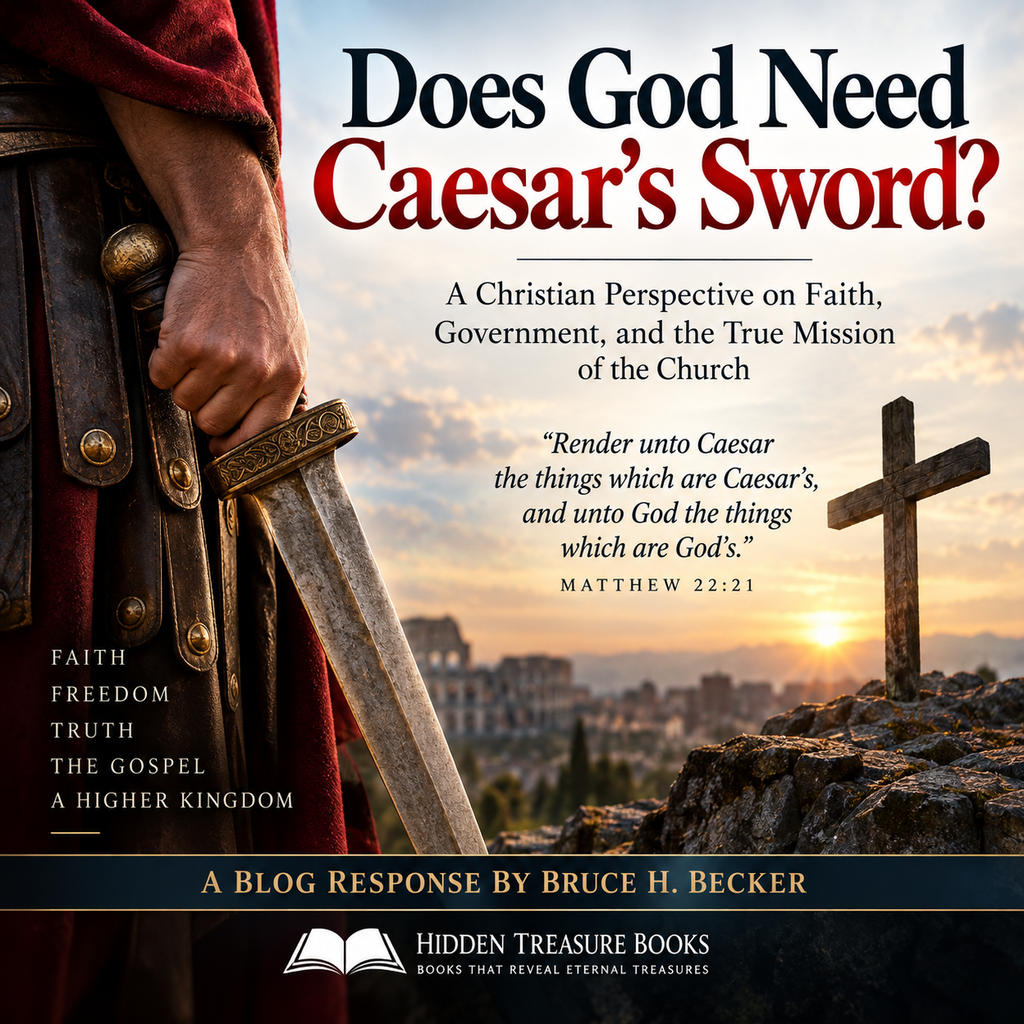
I read Garey Walker’s article, Does God Need Caesar’s Sword?, with great interest. I am not Southern Baptist, and I do not have a dog in that particular fight. But I am a Christian, and the questions raised in his article are important enough that I wanted to offer my perspective.
The issue, as I understand it, centers on Al Mohler’s comments concerning blasphemy laws and the broader question of whether government should enforce Christian beliefs. Walker does an excellent job of narrowing the discussion. The question is not whether Christians should participate in government or whether biblical principles should influence how Christians think about law, justice, morality, and society. The deeper question is this:
Should Christians use the power of government to enforce Christian doctrine?
That question concerns me.
When I hear Christians discussing the possibility of creating a government that enforces Christian beliefs, I cannot help but think about what happens when religious conviction and political power become joined together. Some may immediately think of Sharia law and the dangers of allowing a religious system to control every aspect of civil life. But we should be willing to ask ourselves an uncomfortable question: If we would be concerned about another religion imposing its theology through government, should we assume that Christianity would somehow be immune from the same dangers?
History teaches us otherwise.
There is an old saying: “Power corrupts, and absolute power corrupts absolutely.” Whether we are talking about Christians, Muslims, atheists, or anyone else, human beings remain human beings. Christians are not magically protected from pride, ambition, greed, or corruption simply because they claim the name of Christ.
Imagine a government in which Christians write the laws, interpret the laws, and enforce the laws concerning Christian doctrine. At what point would corruption enter the system? And perhaps more importantly, who would determine which Christians are actually interpreting Christianity correctly?
Christianity itself teaches us that people can become apostate. Scripture repeatedly warns believers about false teachers, deception, and those who appear religious while their hearts are far from God.
So what happens when a government claims to act in Christ’s name, but those operating the government no longer truly reflect Christ?
That is where I become particularly concerned.
Walker points out that blasphemy is serious. I agree completely. God’s name is holy. Scripture does not treat blasphemy as something insignificant. But there is a difference between something being sinful before God and something being punishable by the civil government. Walker notes that under the Mosaic covenant Israel had a specific civil penalty for blasphemy, but Israel was a unique covenant nation. The church is something different: a people drawn from every nation and united through Christ.
That distinction matters.
Consider the unforgivable sin Jesus identifies: blasphemy against the Holy Spirit. Who is truly capable of judging whether a particular person’s heart has committed that sin?
God is.
Scripture tells us that human beings look at outward appearances, while God looks at the heart. If someone has truly committed a sin that only God can ultimately judge, shouldn’t we trust the righteous Judge to render the final judgment?
This leads to another concern: What happens to the Great Commission if Christianity becomes identified with government coercion?
Jesus commanded His followers to go into the world and make disciples. He did not tell His disciples to establish a government capable of forcing people to believe. Paul entered Athens and confronted false religion directly. He reasoned with people. He proclaimed the truth. He called people to repentance.
The weapon Paul used was truth.
That distinction is enormously important.
If a government uses the name of Christ to imprison or punish someone for what that person believes about God, how does that help us demonstrate the love of Christ to that person?
How do we tell someone, “Jesus loves you,” while the government claiming to represent Jesus is threatening to punish you for rejecting Him?
There is another passage that continually comes to my mind.
Jesus said, “Render unto Caesar the things which are Caesar’s, and unto God the things which are God’s.”
Jesus lived under a government that was hardly Christian. He could have rejected Caesar’s authority. He could have called down legions of angels. He could have taken control of the governments of the world.
He did not.
Instead, He chose the cross.
Jesus demonstrated His kingdom not by seizing political power, but by serving, sacrificing, forgiving, and ultimately giving His life for sinners.
That does not mean Christians should abandon government or public life. Christians should participate in society. We should vote. We should speak for justice. We should defend the vulnerable. We should stand for what we believe is right. Walker makes this same distinction: Christian engagement in public life is not the same thing as using civil authority to enforce Christian orthodoxy.
But there is a line we should be very careful about crossing.
When the church begins depending upon the sword of government to accomplish what Christ commissioned the church to accomplish, we need to stop and ask ourselves whether we have forgotten where the real power of the gospel comes from.
Paul wrote that the gospel is the power of God for salvation.
Not Caesar.
Not Congress.
Not a political party.
Not a government.
God.
The early church changed the world without controlling Rome. In fact, Rome often persecuted Christians. Yet the gospel continued to spread.
That should tell us something.
Our confidence should not rest in our ability to gain political power. Our confidence should rest in Christ.
The government has a legitimate role in maintaining civil order. The church has a divine calling to proclaim the gospel. Those responsibilities should not be confused.
Blasphemy is serious. Sin is serious. False teaching is serious. Unbelief is serious.
But so is the freedom of conscience.
And perhaps the question we Christians should be asking is not, “How much political power can we gain in the name of Christ?”
Perhaps we should be asking:
“How faithfully can we represent Christ with the authority He has actually given us?”
Jesus did not need Caesar’s sword to establish His kingdom.
And He still doesn’t.
#DoesGodNeedCaesarsSword
#ChristianFaith
#Christianity
#FaithAndGovernment
#ReligiousLiberty
#FreedomOfReligion
#ChristianFreedom
#ChurchAndState
#ChristianWorldview
#BiblicalTruth
#BiblicalPerspective
#TheGospel
#JesusChrist
#ChristIsKing
#KingdomOfGod
#GreatCommission
#FaithOverFear
#ChristianLiving
#ChristianThought
#ChristianBlog
#BibleTruth
#Scripture
#FaithAndCulture
#ChristianPublicLife
#GospelMessage
#FollowJesus
#TrustChrist
#RenderUntoCaesar
#Matthew2221
#HiddenTreasureBooks